
The Hills Are Looking Green at Last
Book litter · South Australia
By Gohachi Books
Between the pages of an old book, a South Australian postcard dated 4 August 1902: a few lines about letters, a cold, a house move and the weather. Its addressee, we discovered, was a young English priest whose life ran from Borneo to the Scottish Highlands. Its sender we have yet to find.
Published October 2026 · About a 5-minute read
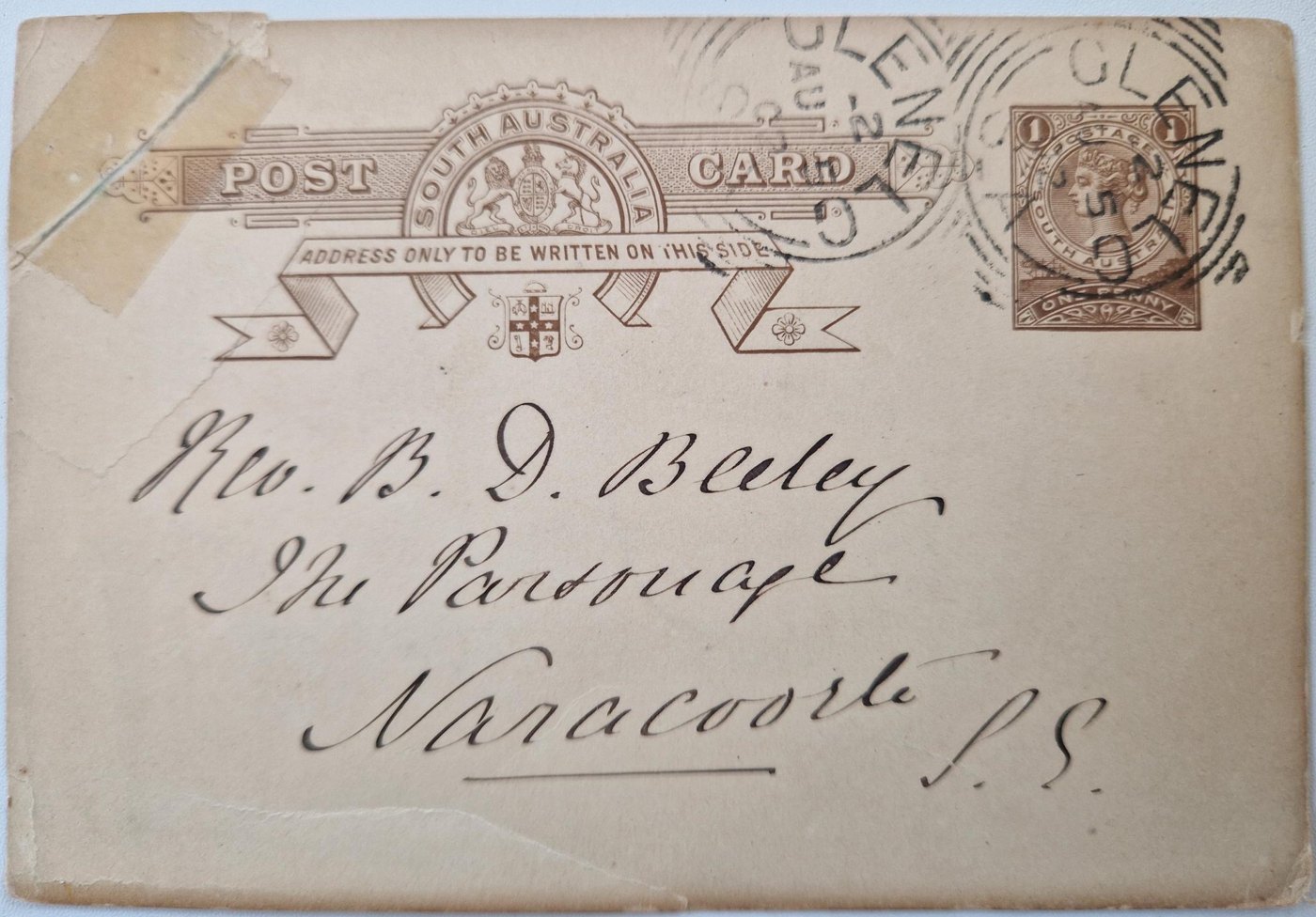
It came out of a book. We were working through a box of secondhand books in West Sussex when a small brown card slid from between the pages and landed on the desk. Which book it came from, nobody now remembers. It is the kind of thing a bookseller finds every week, and almost always it is nothing.
This one was a South Australian postcard, sent from Glenelg on 4 August 1902.
A Penny Card
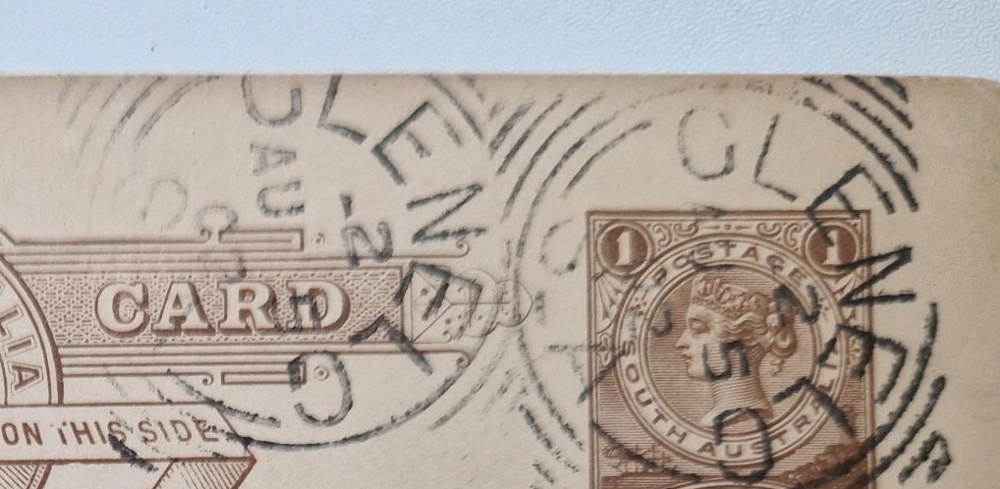
It is a plain government postal card, the kind bought at the post office with the postage already printed on it. In the corner is a one-penny stamp bearing the head of Queen Victoria, though the old Queen had been dead for eighteen months when this card was posted. Across the top runs a stern instruction: “Address only to be written on this side.” Two Glenelg postmarks have been struck across the stamp and the printed panel beside it.
The card has lived a hard life since. It is creased and spotted, and a corner has torn and been mended with tape that has itself turned the colour of tea.
The address is written in a confident copperplate:
Rev. B. D. Beeley
The Parsonage
Naracoorte
S.A.
The Message
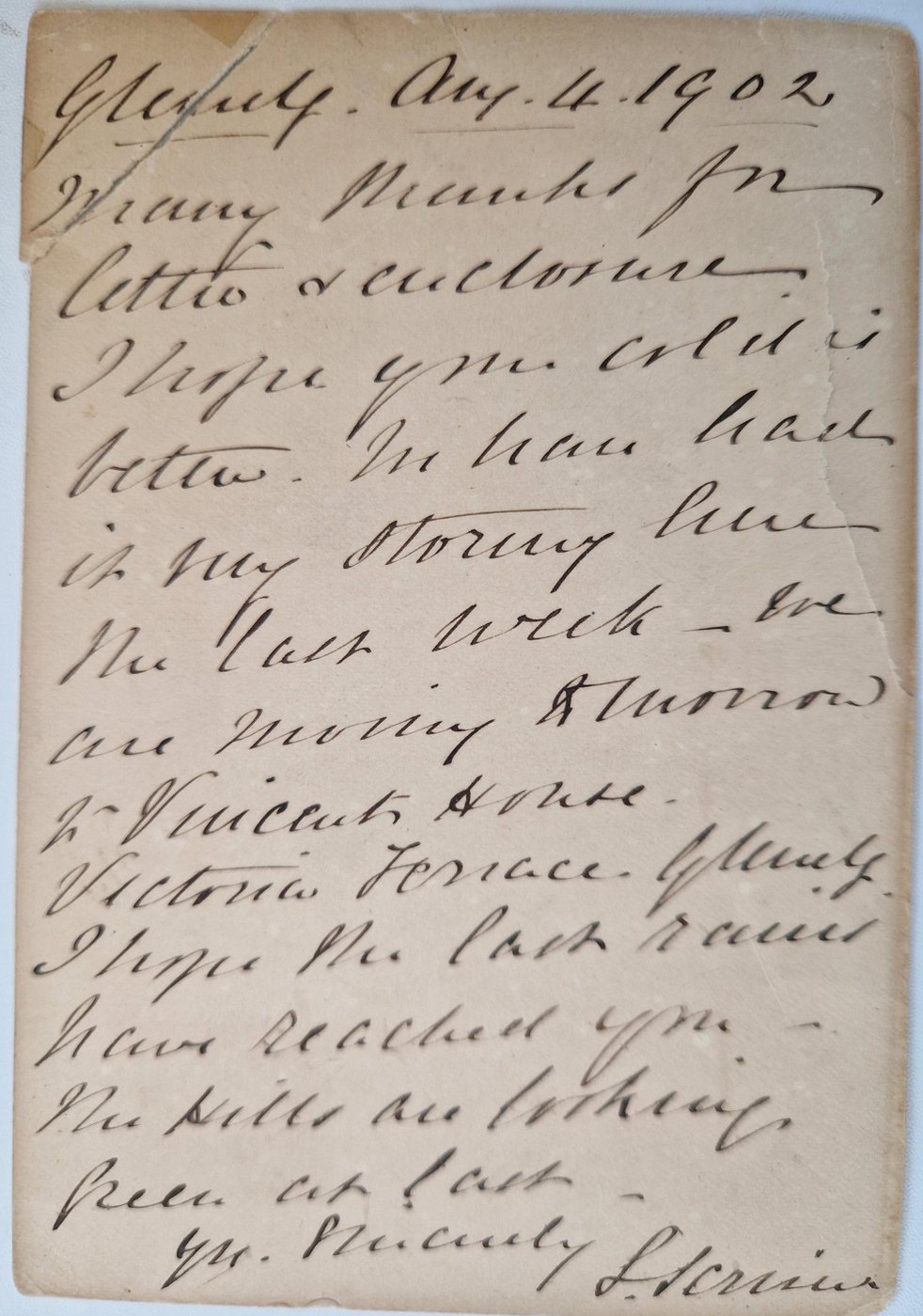
Turned over, the card holds a few short lines in a sloping, careful hand:
“Glenelg. Aug. 4. 1902.
Many thanks for letter & enclosure. I hope your cold is better. We have had it very stormy here the last week – we are moving tomorrow to ‘Vincent House’, Victoria Terrace, Glenelg. I hope the last rains have reached you – the hills are looking green at last –
Yrs. sincerely …”
The signature begins with a clear “L.” The surname that follows has defeated us. It might be read several ways, and we would rather leave it unread than guess.
Nothing in the message is momentous, and that is its charm. A letter has arrived with something enclosed. Someone has had a cold. There has been a week of bad weather. A household is packing up to move. And then the line that stays with you: the hills are looking green at last.
The Parson of Naracoorte
The address could be traced. The records of the Anglican Church in Australia list a Reverend Ben Darcy Beeley as priest-in-charge of the mission district of Naracoorte, Bordertown, Lucindale and Wolseley from 3 April 1902 to 31 May 1905. Naracoorte is a country town in the south-east of South Australia, near the Victorian border, and its Anglican church is St Paul's, built of local limestone in 1880.
Beeley was not Australian. He was born at Cleethorpes, on the Lincolnshire coast, on 8 March 1875, the son of a malt factor. He trained for the mission field at St Augustine's College, Canterbury, and was ordained deacon in Sarawak, on Borneo, in 1899, where he served as a missionary at Banting. By November 1900 he was in Adelaide, and after eighteen months at Port Wakefield he was sent to Naracoorte. He was twenty-seven when this card reached him, a few months into his new post.
A letter in the University of Adelaide's archives shows him in August 1903, the year after our card, writing from Naracoorte about the number of candidates needed to hold one of the university's local examinations in the town that November. It is the ordinary business of a country parson. In October 1904 he married Clara McCulloch at Urana, New South Wales.
A Green Winter in a Dry Land
“The hills are looking green at last” was not an idle remark in 1902. Australia was in the grip of what is now called the Federation Drought, which ran from the mid-1890s into 1903 and roughly halved the nation's sheep flock. Across the continent 1902 was the record dry year. April 1902 was the driest month of the twentieth century, averaged over all Australia.
Yet drought is never even. Historians of the period note that parts of South Australia had a wet winter in 1902, even while the inland stayed parched. We have not been able to confirm, from the newspapers of the day, the storms of that particular week at Glenelg. The card itself is our only witness. But the writer's relief is unmistakable, and so is the hope that the same rain had reached a parish nearly two hundred miles to the south-east.
Letters from the Bush
Australian writing of these years was full of drought. In April 1901 an Edinburgh publisher, William Blackwood, brought out My Brilliant Career, written by a nineteen-year-old from the New South Wales bush under the name Miles Franklin. In one chapter, “The scorching furnace-breath winds shrivelled every blade of grass, dust and the moan of starving stock filled the air.”
The book itself began with a letter. Henry Lawson, who helped it into print, opened his preface: “A few months before I left Australia I got a letter from the bush signed ‘Miles Franklin’.”
We should be clear. We have found no connection between our card and Franklin, Lawson or any other writer, and we have not tried to invent one. The card belongs to the same world as those books, a world that ran on letters, and that is all.
The Long Way Round
How did a card posted between two South Australian towns come to rest in a book in England?
We can only offer the facts and let them suggest what they will. On 31 May 1905 Ben Beeley left Naracoorte for a visit to England. He did not return to Naracoorte. He served as a curate in Durham, worked for a missionary society in Devon and Cornwall, and in 1908 went to India as a chaplain. He was with the Expeditionary Force in Mesopotamia in 1916 and 1917. Later he served a parish in Kent and churches in Aberdeenshire, and he died at Aboyne, on the Dee, on 16 August 1958.
If the card travelled with him, it travelled a long way. But it may equally have stayed in Australia for decades and crossed the world later in someone else's luggage, or in a box of books. We do not know who kept it, which book it lived in, or for how long.
What Books Keep
A book is printed in thousands. Its owners are not. Every secondhand copy carries a trace of the people who held it, and now and then the trace is a name, a date, a sentence in someone's hand.
This one is a sentence about the weather, written on a Monday in August 1902 by a person whose name we cannot read, to a young priest who would spend the rest of his life on the move. It survived because someone, somewhere, put it between two pages and closed the book.
Somewhere in South Australia, that winter, the hills were looking green at last.
At Gohachi we open every book before it goes on the shelf, because the stories are not always printed. If you can read the signature, or know Vincent House, please tell us.
Researched and written for Gohachi Books, October 2026, from the postcard in our collection and the sources listed below.
Sources
• Cable Clerical Index of Australian Anglican clergy: Beeley, Ben(jamin) Darcy
• Church Histories: St Paul's Anglican, Naracoorte
• University of Adelaide archives: B D Beeley, Naracoorte, re holding exam (1903)
• Wikipedia: Federation Drought
• National Museum of Australia: Federation drought
• National Museum of Australia: My Brilliant Career
• Project Gutenberg: My Brilliant Career, by Miles Franklin
Ben Darcy Beeley
- 1875
- Born at Cleethorpes, Lincolnshire
- 1899
- Ordained deacon in Sarawak; missionary at Banting
- 1900
- Arrives in Adelaide; Port Wakefield
- 1902
- Priest-in-charge, Naracoorte (April)
- 4 Aug 1902
- Our postcard is written at Glenelg
- 1904
- Marries Clara McCulloch at Urana, NSW
- 1905
- Leaves for England
- 1908–28
- Chaplain in India; Mesopotamia 1916–17
- 1958
- Dies at Aboyne, Aberdeenshire
Researched and written for Gohachi Books, October 2026, from the postcard in our collection and the sources listed below.

