
The Minister from the Valley
Book litter · Wales & Portsmouth
By Gohachi Books
A yellowed cutting from 1950, a press photograph stamped in Portsmouth and a picture of a flint chapel. Together they tell the story of Ivor Thomas, a young man from the Welsh coalfield who followed a revival preacher from his own village to the south coast.
Published October 2026 · About a 4-minute read
Books collect things. The book litter comes to us tucked inside the books we buy: tickets, cards, letters and photographs. Sometimes we aren't paying attention and end up not knowing which book they came from. But some of them belong together, and these do.
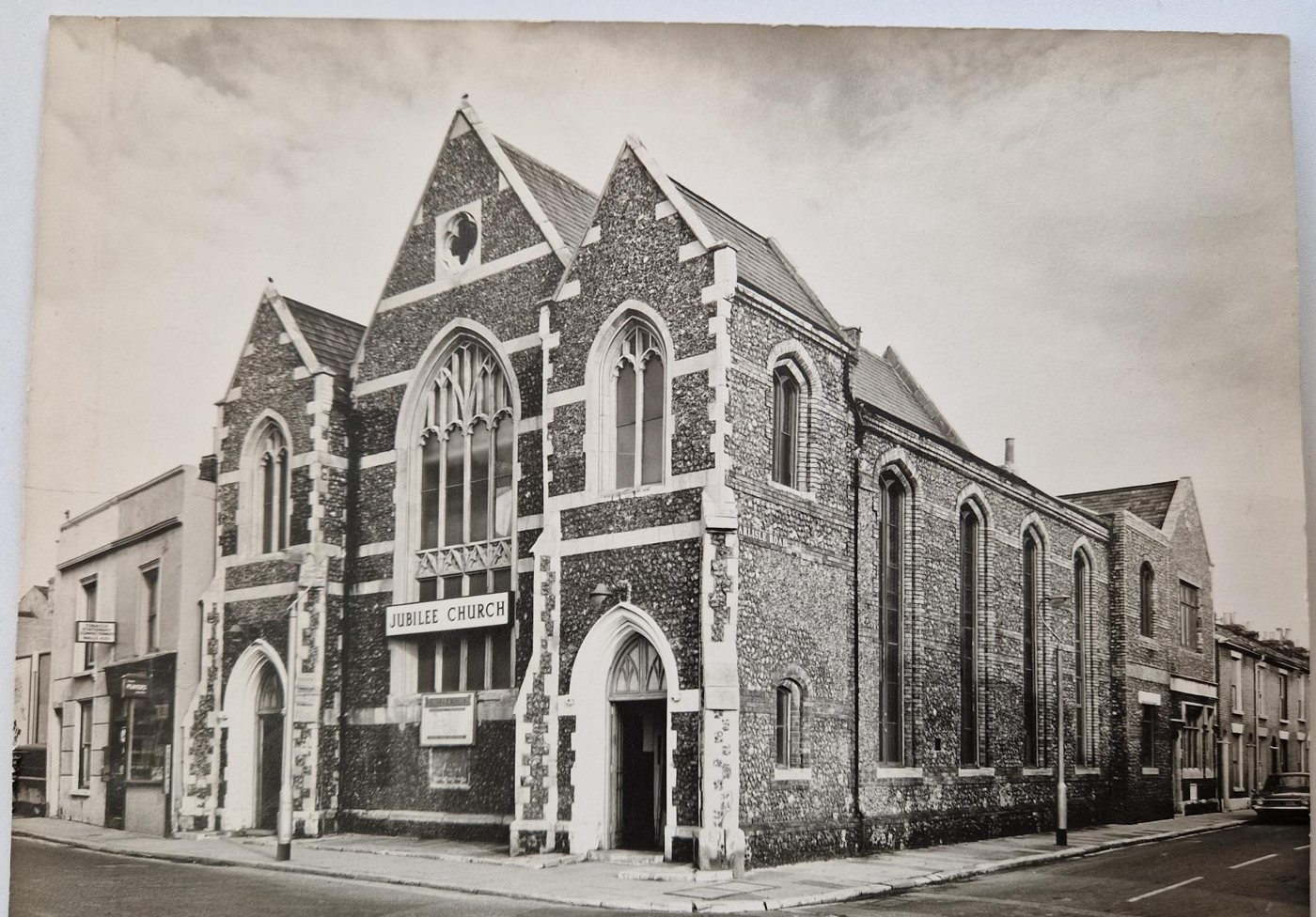
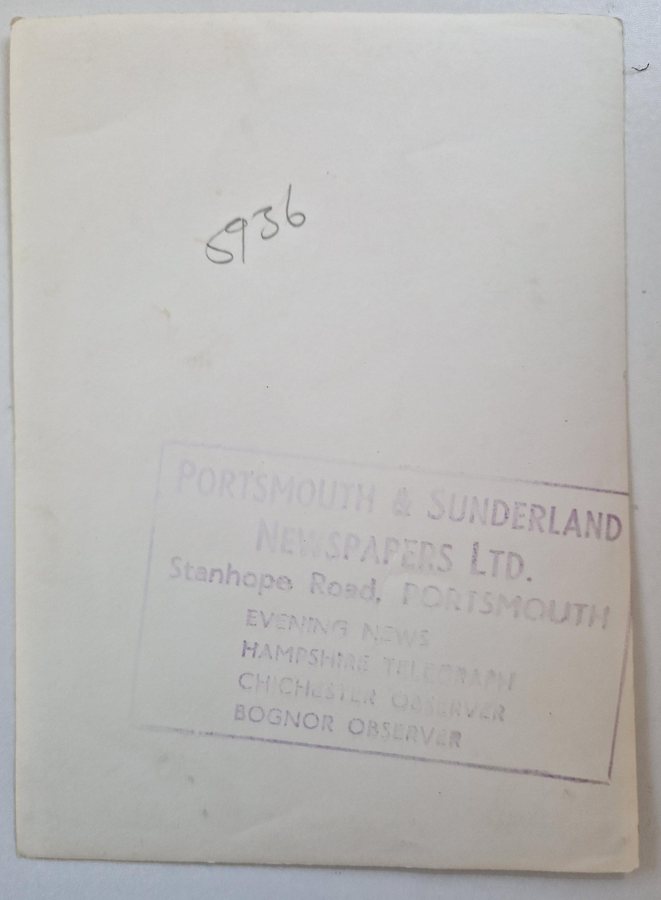
There is a narrow newspaper cutting, dated 17 March 1950, headed “Mr. Ivor Thomas”. There is a studio portrait of a smiling minister in a clerical collar, and a photograph of the same man in an empty church, beneath an organ and a gallery. And there is a picture of a flint chapel on a street corner, with a sign above the door: JUBILEE CHURCH. Two of the photographs carry the stamp of Portsmouth & Sunderland Newspapers, the publishers of Portsmouth's Evening News.
The Cutting
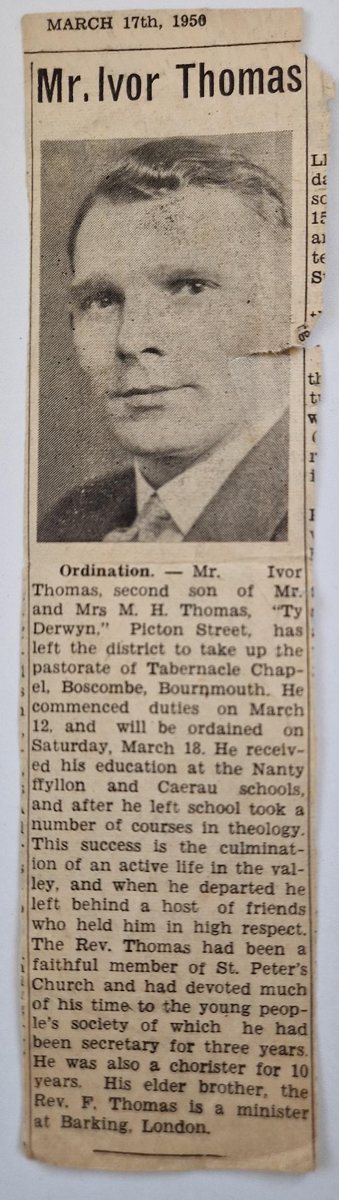
The cutting comes from a Welsh valleys paper. Ivor Thomas, it says, was the second son of Mr and Mrs M. H. Thomas of “Ty Derwyn”, Picton Street. He had been educated at the Nantyffyllon and Caerau schools, in the Llynfi valley above Maesteg, and after school he had taken “a number of courses in theology”.
He had been a faithful member of St Peter's Church, secretary of its young people's society for three years and a chorister for ten. Now he had “left the district to take up the pastorate of Tabernacle Chapel, Boscombe, Bournemouth”. He began work there on 12 March and was to be ordained on Saturday, 18 March 1950. His elder brother, the Rev. F. Thomas, was already a minister, at Barking in London.
“This success is the culmination of an active life in the valley, and when he departed he left behind a host of friends who held him in high respect.”
A Preacher from the Same Village
Nantyffyllon is a small place, and it had already produced one famous preacher. George Jeffreys was born there on 28 February 1889. As a boy of fifteen, during the great Welsh Revival, he was converted on 20 November 1904, together with his older brother Stephen.
George Jeffreys became the most successful British evangelist of his day. In 1915 he founded the Elim movement, which grew into one of Britain's main Pentecostal churches. In 1939 and 1940 he broke with Elim and started a new fellowship of his own, the Bible-Pattern Church Fellowship.
Ivor Thomas, it turns out, followed him. A Pentecostal Tabernacle in Boscombe was one of the churches of the Bible-Pattern Fellowship, and it was in that fellowship that Ivor spent his ministry.
Jubilee
In 1956 Pastor Ivor D. Thomas took charge of the Bible-Pattern church in Portsmouth. It met in “Jubilee”, a flint-faced chapel in Somers Road, Southsea, built in the nineteenth century for the Primitive Methodists. The Bible-Pattern congregation had bought it in 1947, and George Jeffreys himself came to the opening.
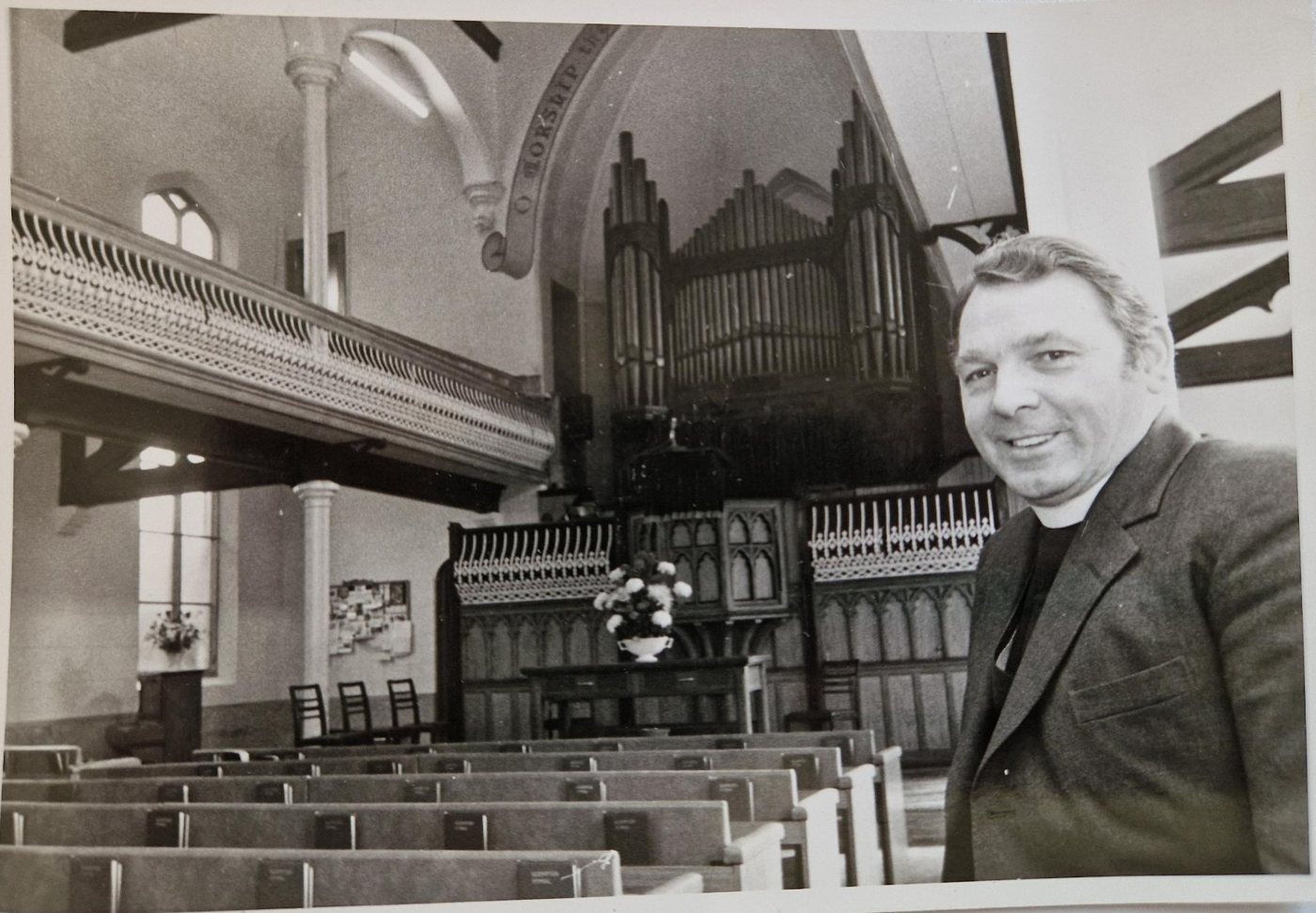
A history of the fellowship's churches remembers how the Thomases first arrived. They slipped into a Wednesday evening young people's meeting, and the young people's secretary kindly showed the visitors round, not realising that the stranger was the new pastor. The two families stayed friends for life.
In 1957 the church held a service for the first anniversary of Ivor's ministry. Principal George Jeffreys and his revival party came to Portsmouth for it, and the service was recorded. Ivor, by then about thirty-seven, gave the opening prayer and a reflection on his first year. Two men from the same Welsh village, three decades apart in age, were sharing a pulpit on the south coast.
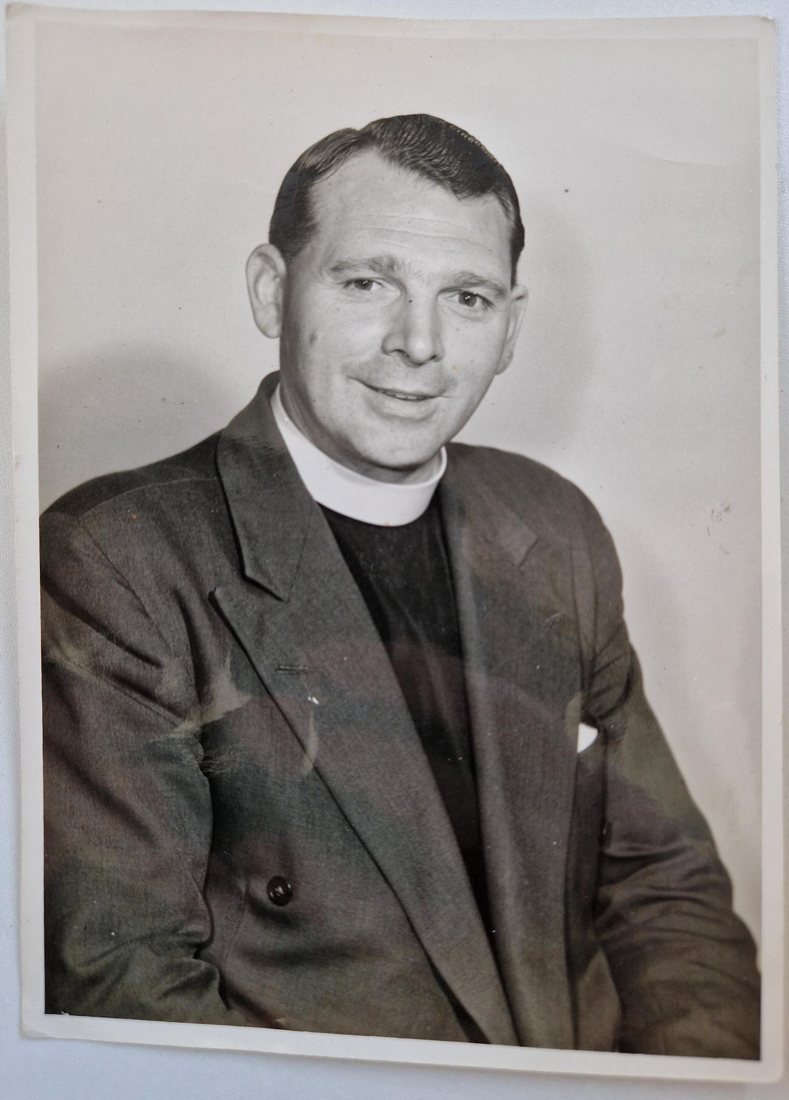
He was liked well beyond his own church. He preached at the large Baptist church at North End and at the St David's Day service at Fratton's Wesley Central Hall. On holiday he went home to Wales, to the fellowship's conference at Cefn Cribwr near Bridgend, and asked his friend Pastor Gwilym Francis to take his pulpit while he was away.
George Jeffreys died in 1962. Ivor Thomas stayed at Jubilee. When he died, his funeral was held in the church, and his widow was looked after by two loyal friends from the congregation, the organist and a retired schoolteacher.
Jubilee Today
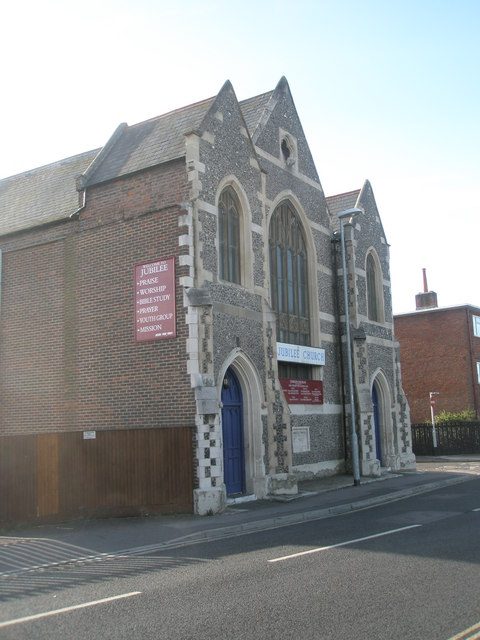
The chapel is still there, and still called Jubilee. It is still a Pentecostal church. Look at the corner of our photograph and you can make out a shop sign for tobacco and stationery, and a Player's cigarette advertisement in the window. On the back of one print, in pencil, is the newspaper's negative number: 5936.
How a minister's cutting and his press photographs ended up loose among secondhand books, we will never know. Perhaps they were kept in a family Bible or a hymn book, and the book went one way and the papers another. They are a small record of a life spent in service: a valley boy, a chorister, a young pastor, and for many years the minister of a flint chapel in Southsea.
Did you know Pastor Ivor Thomas, or worship at Jubilee? We would love to hear from you. And if you find anything tucked inside a book from Gohachi, tell us its story.
Researched and written for Gohachi Books, October 2026, from the cutting and photographs in our collection and the sources listed below.
Sources
• The Bible-Pattern Church Fellowship: Southsea, Portsmouth Jubilee Pentecostal Church
• Wikipedia: George Jeffreys (pastor)
• My Primitive Methodists: Southsea Somers Road Jubilee chapel
• Wikimedia Commons: Jubilee Church, Somers Road (photo, 2008)
From the valley to Southsea
- 1889
- George Jeffreys born in Nantyffyllon
- 1904
- The Welsh Revival; Jeffreys converted
- 1915
- Jeffreys founds Elim
- c. 1920
- Ivor Thomas born
- 1940
- Jeffreys founds the Bible-Pattern Church Fellowship
- 1947
- The fellowship buys Jubilee, Southsea
- 1950
- Ivor ordained at Tabernacle, Boscombe
- 1956
- Pastor at Jubilee
- 1957
- Anniversary service with George Jeffreys
- 1962
- Jeffreys dies
Researched and written for Gohachi Books, October 2026, from the cutting and photographs in our collection and the sources listed below.


